AI product photography for perfume brands: glass, liquid and light that hold up
How we make AI perfume images that look expensive, not fake: an honest packshot, glass and liquid that obey the light, Q4 campaigns, and where to skip AI.
Perfume is sold almost entirely on images. Nobody can smell a bottle through a screen, so the picture has to carry the mood, the price point and the reason to buy, and a fragrance brand needs a lot of them: the product page, every season, every gift moment, every ad size.
That's why AI product photography for perfume is such a tempting idea. Most of what you'll find on it is tool pages that show one glossy bottle and stop there. They don't say why so many AI perfume images look like cheap renders, or which images a fragrance brand should never let AI make.
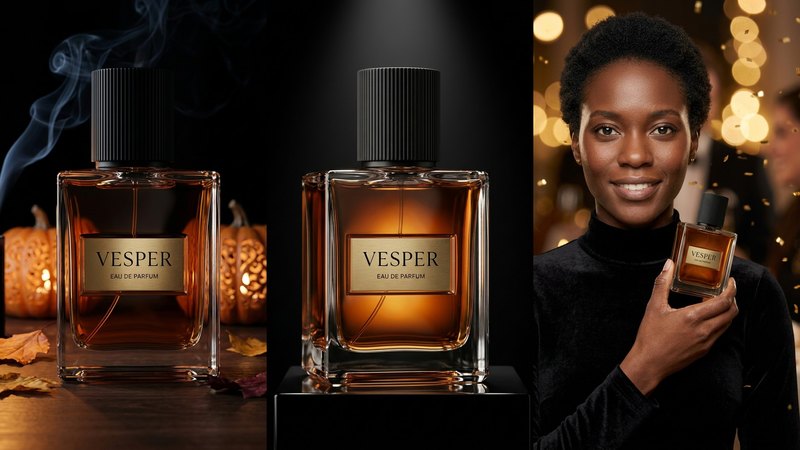
We make AI product images and video ads for DTC brands. To see what holds up for fragrance, we invented one, VESPER (a heavy square bottle of amber eau de parfum with a matte black ribbed cap and a brushed-gold label), and built a full Q4 campaign from one packshot. VESPER is a concept brand, not a client. Here's what it taught us.
1. Start from one honest packshot
Every scene copies the bottle from somewhere, so that somewhere has to be right. For VESPER the input was one clean front view on a plain warm grey background, in soft even light, with the label square to the camera. A phone photo works if it's sharp, straight and true to colour.
Then check every image against it. Perfume bottles drift in particular places:
- the glass: how thick the walls are, and the bevel on the edges. AI likes to make heavy glass thin,
- the liquid: the colour and the fill line. Amber turns orange or brown, and the level moves,
- the cap: the ribbing, the finish (matte or gloss) and its height against the bottle,
- the label: every letter. The big name usually holds; the small print ("eau de parfum", the volume) is where it slips.
On our New Year shot, "VESPER" came out perfect and "EAU DE PARFUM" turned into nonsense at thumbnail size. That's normal. Zoom to 200% and read it before it goes anywhere. More on this in 5 AI mistakes we caught.
2. Glass and liquid need the light to make sense
A perfume bottle is mostly transparent, which means it's mostly reflections, refractions and the colour of what's behind it. That's exactly what makes AI perfume images look fake when they're wrong: glass that's lit from two directions at once, liquid that glows with no light behind it, a reflection that doesn't match the room.
What worked for VESPER was choosing one light and saying what it does:
- one source, named: "one hard spotlight from directly above" or "warm candlelight from the left",
- what the glass does with it: "the bevelled edges catch bright highlights",
- what the liquid does with it: "the amber perfume glows", which only happens when light passes through it,
- what it touches: "a crisp reflection on the plinth", so the bottle sits on something real.
Our Black Friday image is that prompt and almost nothing else: a black cube, a black backdrop, one spotlight. It works because there's only one light to get right. If you want the colour of the backdrop to do the talking, our guide to product photo background colours has the four we'd start with, and black is the one for fragrance.
3. Lock the bottle, change the season
Fragrance is a gift category, so Q4 is when the images matter most, and most brands need four looks in eight weeks. Booking four shoots for that is where the budget goes. With AI the bottle stays fixed and only the world around it changes.
For VESPER we made four campaigns from the same packshot:
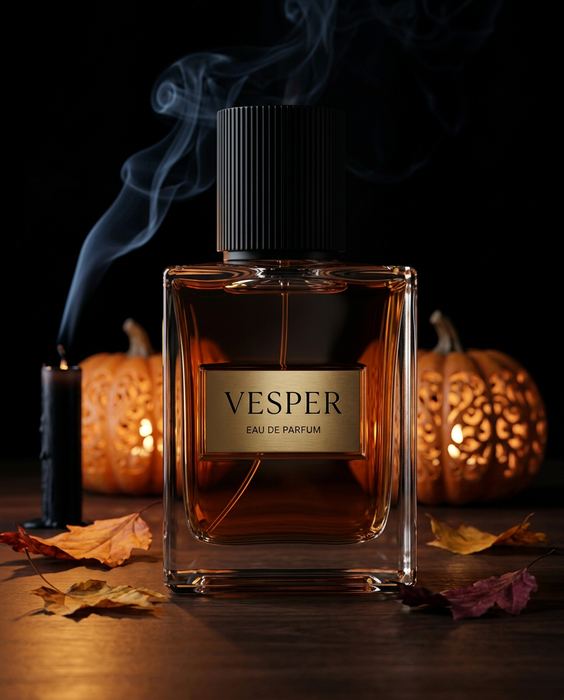
1. Halloween: the bottle on a dark walnut table, carved pumpkins glowing out of focus, a curl of candle smoke. Moody and elegant, not a costume party.
2. Black Friday: the spotlight shot, with the top third and the bottom fifth left as clean black space for the offer.
3. Christmas: two hands in a cream knit unwrapping the bottle from kraft paper and a red velvet ribbon.
4. New Year: a model holding the bottle near her collarbone in falling gold confetti.
The exact prompts and the dates to have each one ready by are in holiday product photography ideas for Q4. The short version: Halloween ads live by 20 October, Black Friday creatives ready by 10 November, and Christmas running until your last shipping date.
Two things we'd tell any fragrance brand doing this. Write the offer onto the image afterwards in Canva or Figma, never in the prompt, because AI misspells small type. And check the bottle's size against everything around it. In our Christmas shot the bottle came out a little large for the hands holding it. A 50 ml bottle that looks like a 200 ml one is a returns problem waiting to happen.
4. If there's a person, make them the same person
Fragrance ads are often a face and a bottle. The trap with AI is that the face changes from image to image, so your "campaign" is five different women. For VESPER we made a character sheet first (front, three-quarter, profile and a smile, all in the same high-neck black velvet top) and attached it to every prompt with a person in it.
Keep the styling in the character description too, not just the face. If the wardrobe isn't written down, it drifts along with everything else.
5. One world for the whole range
A fragrance house usually has more than one scent, and the range only reads as a brand if every bottle lives in the same world. Write the palette, the light, the surfaces and the props once (for VESPER: black, amber and brushed gold; warm low light; walnut, velvet and smoke) and paste the same block into every prompt. How to write one: Don't copy a prompt, build a world.
For video, start from your best checked still rather than from text, so the bottle stays the bottle. A slow push-in on the spotlight shot, or the smoke drifting past the Halloween bottle, is enough for a 15-second ad. The method is in AI product video from one image.
Where we wouldn't use AI for perfume
This is the part most AI tool pages leave out.
- The real liquid colour. If your juice is pale gold, show pale gold. AI loves a deep amber glow. Check every image against the real bottle on a calibrated screen.
- The real size. Shoppers judge value from the image. Make sure the bottle is the size it is, next to hands, boxes and props.
- Packaging close-ups you'll be judged on. Engraving, a magnetic box, a cap that clicks: if the image shows a detail as a selling point, it should be your real detail.
- Notes and ingredients. A shot that shows "bergamot, vanilla and oud" with fruit and pods around the bottle is fine as mood. Don't let it suggest ingredients that aren't in the formula.
Where a platform or market requires AI disclosure, apply it. Honest, labelled, good-looking images still sell.
What it costs, roughly
A studio shoot for a set like this, four seasonal setups plus a model, typically runs $2,000 or more and takes 2–3 weeks, and it has to happen before the season, not during it. Doing it yourself with ChatGPT or Gemini costs a subscription and your time, and you check every letter on the label yourself. Our Pilot is $199 for 8 images and a 15-second vertical video in 5 days, made from the photo you already have. Here's the side-by-side comparison.
Do it yourself, free
Everything above is written out step by step, with the exact prompts, in our free library (no email, no sign-up). For fragrance, start with the Q4 campaign prompts, then the AI product image checklist before anything goes live.
If you'd rather we did it, send one photo of your product and we'll send back a direction.
The free guides behind it.
 Step 12
One photo, every Q4 campaign
Halloween, Black Friday, Christmas, New Year: four campaigns from one packshot, and when each must be live.
[ Open the guide → ]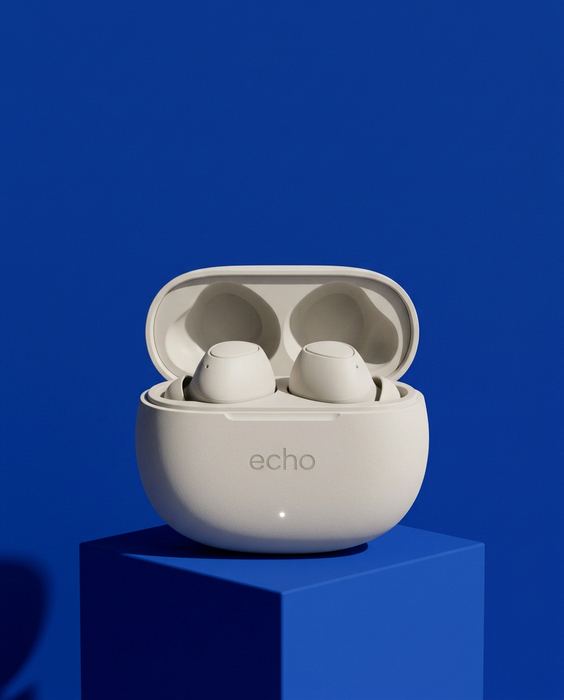 Step 06
Your backdrop is talking
Sage, cobalt, blush and black: what each backdrop colour says, the light that goes with it, and the one to avoid.
[ Open the guide → ] Step 01 · Start here
The AI product image checklist
Lock the product, go close, test the colour, build the world. The checks we run on every set.
[ Open the guide → ]