ChatGPT product photography prompts, tested on one real product
Eight copy-paste ChatGPT prompts for product photos, each run once on the same bottle: white background, flat lay, lifestyle, dark, gift, hand, ad and mist.
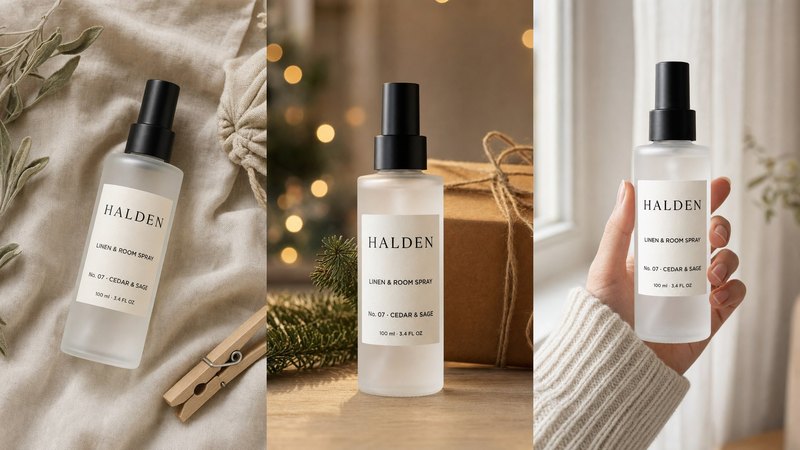
The ChatGPT product photography prompts that work are the ones that say what must stay the same before they describe the scene. We ran eight of them, once each, on the same product photo. Every label came back correct, letter for letter, and the scenes changed exactly where we asked.
The product is HALDEN No. 07, a linen and room spray from a concept brand we made for this series (an invented brand, not a client). Its label has four lines of text, which makes drift easy to spot. Its packshot stands in for your own product photo.
How we tested. On 7 October 2026 we sent the HALDEN packshot to OpenAI's current image model through its API (gpt-5.4-image-2), with one prompt at a time, in 4:5 portrait. One run per prompt, no retries, no edits afterwards. The ChatGPT app may give slightly different results. Each image cost us about $0.19.
The line that goes in front of every prompt
This is what keeps the product the same. Attach your photo, paste this first, and fill in your own details:
"Use the product in this photo and keep it exactly as it is: the same [material and colour of the pack], [the cap, pump or lid], and the label text letter for letter: '[line 1]', '[line 2]', '[line 3]'."
And end every prompt with: "Portrait 4:5. Photorealistic. Do not add any other text, logos or labels."
The eight scene lines below go in between. Why each part matters is in the anatomy of a real-looking prompt.
1. The clean white background
"A clean e-commerce packshot on a pure white background, soft even studio light from both sides, a soft natural shadow under the bottle, the bottle centred and filling about 70% of the frame height."
What happened: a crisp, evenly lit packshot with a soft shadow. The bottle came out a little bigger than we asked, at about 80% of the frame's height. For a marketplace main image, use your real photo instead (more on that below).
2. The flat lay
"A top-down flat lay on softly crumpled oatmeal linen: the bottle lying on its side with the label facing up, a few sprigs of dried sage, a small linen pouch and a wooden clothes peg around it, soft daylight, calm and natural."
What happened: the bottle lay down convincingly, with the label curving around the glass and still readable. The props were all ones we named. This is the most "styled" result of the eight.
3. The lifestyle scene
"A sunny laundry room: the bottle on a white wooden shelf above a wicker basket of neatly folded white towels, morning light from a window on the left, fresh and clean, the label facing the camera."
What happened: a believable room, but the bottle shrank to about 40% of the frame. In a busy scene, say how big the product should be, as we did in prompt 1.
4. The dark, premium shot
"A dark, premium shot: the bottle on a black stone plinth against a deep charcoal backdrop, one narrow rim light outlining the bottle, a faint reflection on the plinth, the label lit just enough to read."
What happened: moody and clean, with the label readable. The rim light was softer than we pictured. If you want a sharper outline, ask for "a bright, hard rim light".
5. The gift scene
"A Christmas gift scene: the bottle on a pale oak table beside a parcel wrapped in brown paper and twine, a sprig of fir, warm fairy lights softly blurred in the background, cosy evening light, the label facing the camera."
What happened: warm and seasonal without turning into a Christmas card, and the bottle stayed the hero. For more holiday ideas, see holiday product photography from one packshot.
6. In hand
"A close-up of a hand in the cuff of a cream knit jumper holding the bottle up near a bright window, the label facing the camera, soft daylight, shallow depth of field, the whole bottle in frame."
What happened: one natural hand, fingers wrapped around the bottle the way a person would hold it, and nothing extra. Always count hands and fingers. This is where AI most often slips.
7. Space for a headline
"An Instagram ad layout: the bottle standing in the lower third of the frame on a sage-green surface against a plain sage-green backdrop, soft light from the left, the whole top half of the frame left empty for a headline."
What happened: exactly the layout we asked for, with a calm, empty top half ready for text. Add the words in an editor afterwards, never in the prompt. Sizes for each placement are in every ad size, one product.
8. The mist
"A fine cloud of spray mist hanging in the air just beside the bottle's nozzle, backlit by soft window light so the droplets glow, the bottle standing on a pale linen surface, airy and fresh."
What happened: a soft, glowing mist at the nozzle, which is hard to get with a camera. Effects like this are where AI earns its keep. More ideas are in AI photo effects for product ads.
What held, and what to watch
- Held in all eight: every line of the label, the frosted glass and the black pump.
- Varied: how big the bottle sat in the frame, from about 40% to 80%. Ask for a size every time.
- Always check: text at full size, hands and fingers, and anything you didn't ask for. Our AI product image checklist is the list we use.
Where we wouldn't use these
- The main marketplace image. Use a real photo of your real product there.
- Fine print. Ingredient lists, warnings and dosage text should be the real label, placed on afterwards.
- Claims of real use. Before-and-after shots and anything presented as a customer photo should be real.
Where a platform or market requires AI disclosure, apply it.
What it costs, roughly
Doing it yourself costs a ChatGPT subscription and the time to check every image. A studio shoot for a set like this typically runs $2,000 or more and takes 2–3 weeks. Our Pilot is $199 for 8 images and a 15-second vertical video in 5 days, made from the photo you already have. Here's the side-by-side comparison.
If you'd rather we did it, send one photo of your product and we'll send back a direction.
The free guides behind it.
 Step 04
The anatomy of a real-looking prompt
Who, what, scene, light, lens, one flaw. The full prompt behind the AURA image, part by part.
[ Open the guide → ] Step 03
5 scenes that sell any product
Window light, hard shadow, the pour, in hand, the table: five prompts for anything you sell.
[ Open the guide → ] Step 01 · Start here
The AI product image checklist
Lock the product, go close, test the colour, build the world. The checks we run on every set.
[ Open the guide → ]